Key Takeaways
-
Always check the trailer's data plate for GVWR and empty weight, then subtract empty weight from GVWR to find true payload; bulk alone doesn't mean you're under the limit.
-
Dense materials like soil, gravel, concrete, and wet yard waste can exceed weight limits long before the trailer looks full, so estimate load weight honestly.
-
Your tow vehicle's payload, hitch rating, and axle limits must also hold up under the trailer's tongue weight, not just the maximum tow rating.
-
Match the trailer type to the material: dump trailers suit loose heavy debris, enclosed trailers protect furniture from weather, and open utility trailers need strong securement.
-
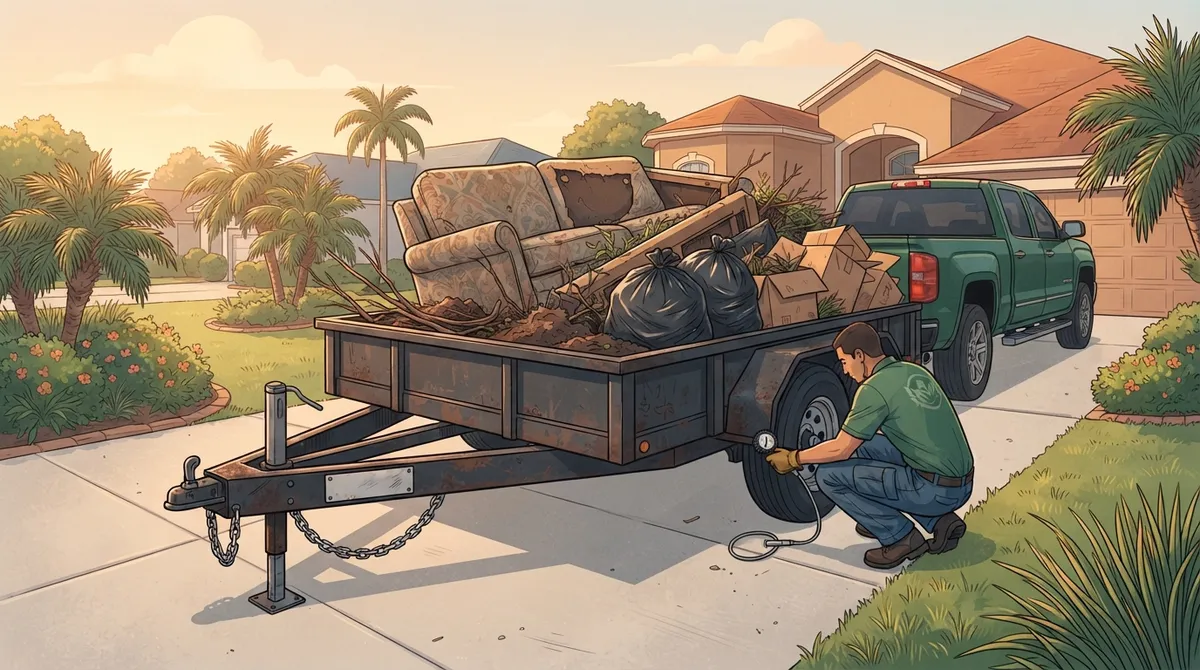
Complete a pre-trip inspection covering tires, coupler, safety chains, lights, and brakes, and recheck straps a few minutes into the drive as loads settle.
-
Call your local disposal site before loading to confirm accepted materials, fees, and hours, since many charge by weight and appliances, paint, and batteries need special handling.
Picture this: it’s a warm Saturday morning in Zephyrhills, FL, and you’ve just rented or borrowed a trailer to haul away that old couch, a pile of palm fronds, and the broken fence panels that have been sitting by the shed for months. You load it up, feel great about it, and hit the road. Then a strap snaps, a tire squeals, or the dump turns you away. Been there? You’re not alone!
Choosing and using a trailer for junk removal looks easy until you’re staring at weight limits, hitch ratings, and tie-down rules. The good news is that most problems come from a handful of common mistakes. In this friendly guide, we’ll walk through ten of them so you can haul smarter, safer, and with a lot less stress. Whether you’re a busy homeowner, a property manager, a contractor, or a senior downsizing a longtime home, these tips are for you. And if you decide hauling is not how you want to spend your weekend, Wayne & Sons Landscaping & Junk Removal is ready to roll up with the right equipment.
Why the Right Trailer for Junk Removal Matters in Zephyrhills, FL
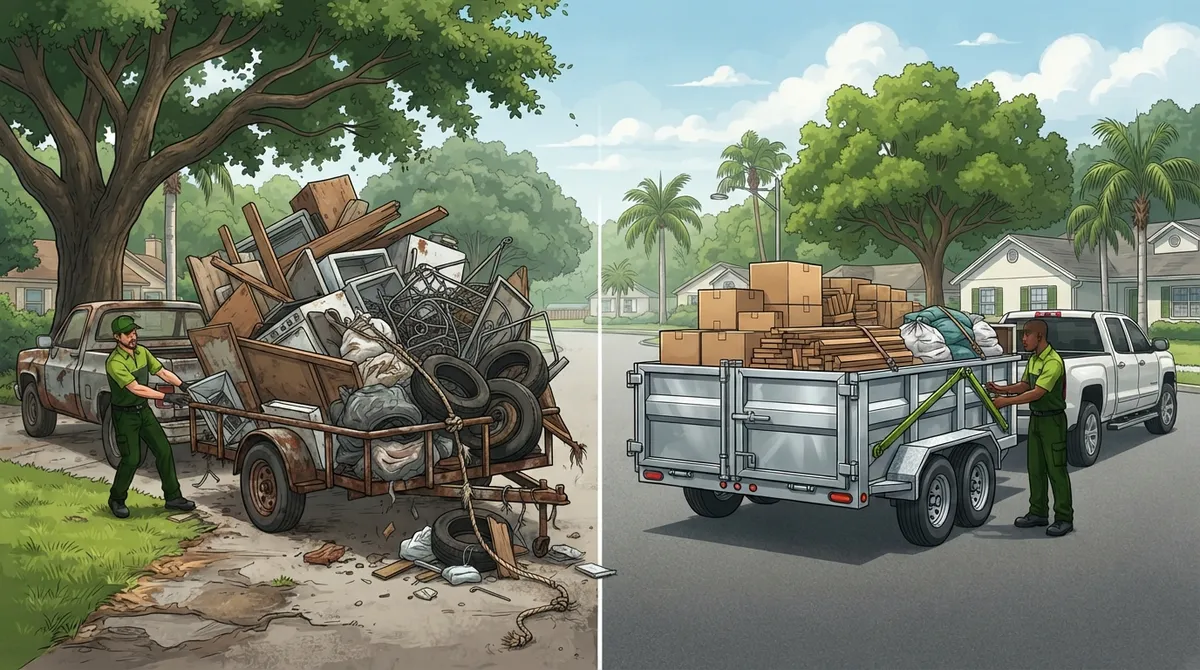
A trailer is only as useful as it is well matched to the job. Yard debris, old furniture, and construction scraps all behave differently on the road. Dense materials like soil, gravel, and concrete can hit weight limits long before the trailer looks full. Bulky, light items like mattresses and cardboard fill the space fast but weigh very little.
Zephyrhills sits in a part of Florida where storms, fast-growing landscaping, and home projects keep debris piles coming. That makes a good hauling plan worth its weight in gold. Let’s look at the mistakes that trip people up most.
Mistake 1: Picking the Wrong Type of Trailer
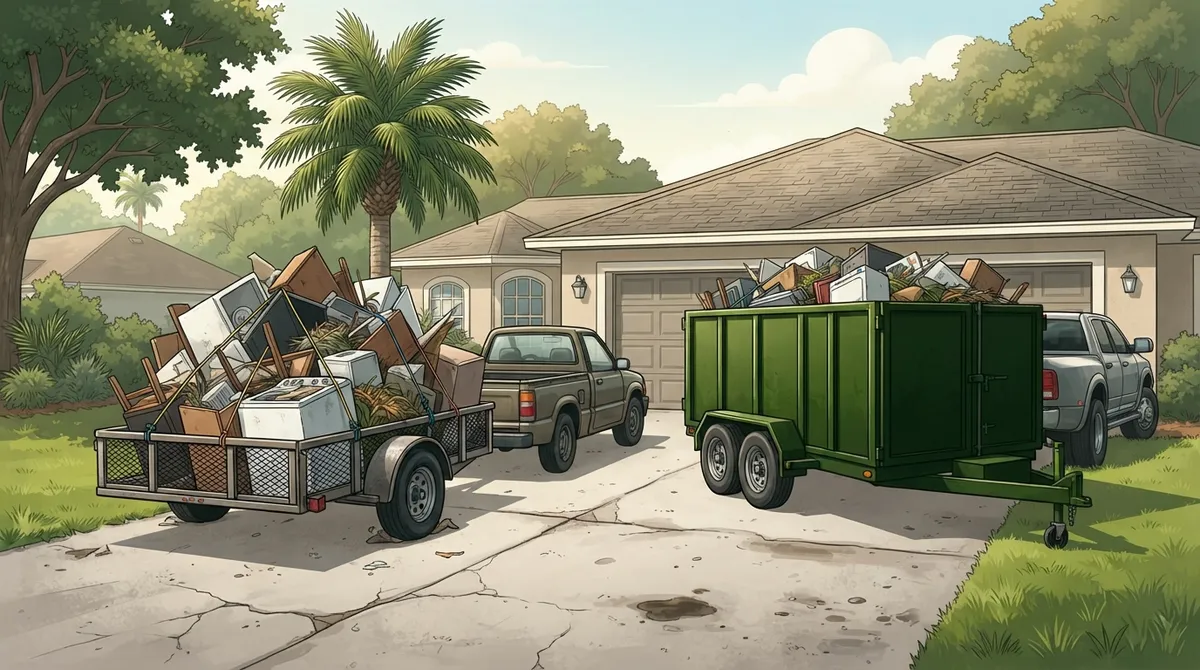
Not every trailer fits every load. Each style has real strengths and tradeoffs, so match the trailer to what you’re hauling.
| Trailer Type | Best For | Watch Out For |
|---|---|---|
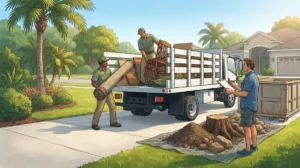
| Dump trailer | Yard waste, soil, construction debris, loose heavy material | Higher cost and heavier empty weight |
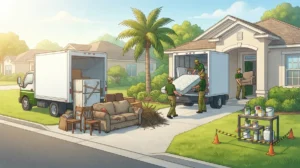
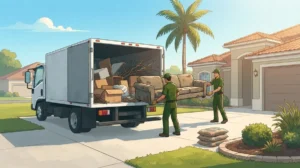
| Enclosed trailer | Furniture, equipment, items needing weather protection | Manual unloading; less ideal for loose debris |
| Open utility trailer | Bulky items you can tie down or cover | Loads are exposed to rain and road debris |
A dump trailer’s hydraulic bed speeds up unloading of yard waste and rubble. An enclosed trailer protects your belongings, which is great for a move or estate cleanout. An open utility trailer offers easy access but demands good securement. Think about the material first, then choose the trailer.
Mistake 2: Ignoring Payload and Weight Limits
This is the big one. Many people judge a load by how full the trailer looks. But weight is what counts. To find your trailer’s payload, subtract its empty weight from its gross vehicle weight rating (GVWR).
For example, one commercial sizing guide lists a 7×14-foot dump trailer with an approximate 3,500-pound empty weight and a 14,000-pound GVWR. That gives a theoretical payload of about 10,500 pounds (TrailerPlace, 2026). A smaller 6×10-foot dump trailer is often cited as a common choice for household junk removal, with a typical GVWR range of 7,000 to 10,000 pounds. Actual numbers vary by model, so always check the trailer’s data plate.
- Find the GVWR on the trailer’s data plate.
- Look up the trailer’s empty weight.
- Subtract empty weight from GVWR to get payload.
- Estimate your load weight honestly, especially with wet debris.
- Stay under the number, with room to spare.
Mistake 3: Trusting the Tow Rating Alone
A truck’s maximum tow rating sounds like the whole story, but it isn’t. Your loaded setup must also stay within the tow vehicle’s payload, hitch rating, and axle limits. The trailer’s tongue weight presses down on your vehicle, which uses up payload too.
- Check your owner’s manual for the tow rating, payload, and hitch class.
- Confirm the hitch, ball, and coupler are all rated for the load.
- Remember that the trailer’s GVWR must also not be exceeded.
- When in doubt, haul smaller loads more often.
A vehicle’s maximum tow rating alone does not prove every loaded combination is safe. Treat it as one piece of a bigger puzzle.
Mistake 4: Skipping the Pre-Trip Inspection
Five minutes of checking can save you a roadside headache. Before every haul, walk around the trailer and look closely.
- Inspect tire condition and pressure, including the spare.
- Confirm the coupler is latched and locked on the ball.
- Cross the safety chains under the tongue and attach them securely.
- Test all lights: brake, turn, and running lights.
- Check brakes and the breakaway equipment if your trailer has them.
- Make sure gates, doors, and latches are closed tight.
If your trailer needs a brake controller, install and test it before you leave the driveway. A loaded trailer also needs extra stopping distance, so leave plenty of space between you and the car ahead.
Mistake 5: Loading Unevenly or Overfilling
A poorly balanced load can make the trailer sway, which is scary at highway speeds. Place heavy items low and near the axle, and spread weight evenly side to side. Keep the load within the trailer sides unless overhang is lawful and properly marked.
- Put the heaviest items down first, centered over the axle area.
- Fill gaps with lighter items so nothing shifts.
- Don’t stack loose debris higher than you can safely secure.
- Keep tongue weight in a safe range so the trailer doesn’t fishtail.
Mistake 6: Not Securing the Load Properly
Loose debris can become a flying hazard. In Florida, it can also earn you a fine. Use strong ratchet straps, cargo nets, or a heavy tarp to keep everything in place.
- Furniture: Strap it down and protect it from wind and rain.
- Yard waste: Cover with a tarp or net so branches and leaves can’t escape.
- Construction scraps: Tie down long boards and keep nails and glass contained.
- Small items: Bag or box them before loading.
Recheck your straps a few minutes into the drive. Loads settle, and straps loosen more often than you’d expect.
Mistake 7: Forgetting About CDL and Commercial Rules
Most homeowners will never need a commercial license for a small utility trailer. But rules do change when the numbers climb. Federal guidance generally sets the Class A CDL threshold at a combination rated at 26,001 pounds or more when the towed unit is over 10,000 pounds (FMCSA, accessed 2026). Federal interstate commercial-vehicle rules generally use a 10,001-pound threshold (49 CFR 390.5).
There’s more. Brake requirements, registration, and securement rules can apply at lower weights or under Florida law. For example, FMCSA guidance addresses brakes on trailers in specified cases (49 CFR 393.42). Because rules vary by state and by whether work is local or interstate, confirm current requirements before you buy or tow a heavy setup. Contractors and property managers hauling regularly should double-check with state authorities.
Mistake 8: Underestimating the Dump and Disposal Side
Hauling is only half the job. You also have to get rid of what’s on the trailer. Many landfills and transfer stations charge by weight, limit certain materials, and have specific hours. Some items, like appliances with refrigerant, paint, batteries, and electronics, need special handling.
Before you load up, call your local disposal site to ask about accepted materials, fees, and hours. Sorting your load ahead of time can also save a lot of time at the scale. If you’re curious how the whole process works behind the scenes, this guide on what really happens during the junk removal process is a helpful read.
Mistake 9: Doing It All Yourself When a Pro Makes More Sense
DIY hauling can be rewarding, but it isn’t always the smartest use of your weekend. Between trailer rental, fuel, dump fees, loading time, and the physical work, costs and effort add up. For seniors, busy homeowners, and anyone with heavy items, hiring help is often safer and easier.
Not sure which way to go? Take a look at this breakdown of hiring junk removal versus doing it yourself. And if you’re weighing the cost of a bigger trailer purchase against hiring out, this comparison of DIY hauling versus pro junk removal can help you decide.
For contractors and builders, a pro crew can also keep job sites clean and on schedule. You may also appreciate this look at dumpster versus junk crew for construction debris removal. The right choice depends on your project size, timeline, and comfort level.
Mistake 10: Not Planning for Landscaping Debris Too
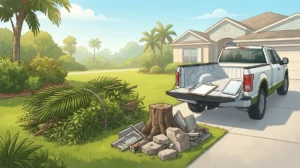
Landscaping jobs create a surprising amount of waste. Palm fronds, tree limbs, old shrubs, sod, and storm debris pile up fast, especially after a Florida storm. Green waste is often heavy when wet, so a trailer that looks half full can already be near its weight limit.
A dump trailer shines here, since the hydraulic bed lets you unload branches and soil quickly. Still, large tree work can be dangerous and may need a professional crew. If you’re also tackling your yard, you might like this overview on whether a landscaper can remove junk from your yard too. The short answer is yes, and that’s exactly the kind of one-stop service we love offering.
Quick Pre-Haul Checklist for Zephyrhills Residents
Keep this list handy before every trip with your trailer for junk removal:
- Confirm trailer GVWR, empty weight, and payload.
- Verify your tow vehicle’s tow rating, payload, hitch, and axle limits.
- Inspect tires, coupler, chains, lights, and brakes.
- Load heavy items low and centered, and balance side to side.
- Secure everything with straps, nets, or tarps.
- Call the disposal site about materials, fees, and hours.
- Know when the job is better left to a professional.
When to Let Wayne & Sons Handle the Hauling in Zephyrhills, FL
Some jobs are simply better with a trained crew and the right equipment. That’s where Wayne & Sons Landscaping & Junk Removal comes in. With over 15 years of experience serving the Tampa Bay area, our team handles furniture, appliances, renovation waste, demolition cleanup, storm debris, and general clutter. We also take care of tree trimming, palm tree care, hedges, and lawn maintenance, so your whole property gets back in shape.
Our customers love the convenience, upfront estimates, and friendly service. Real estate agents prepping a listing, landlords turning over a unit, and families downsizing a loved one’s home all count on us to make the process smooth. You can also see what neighbors say about us by reading reviews on Thumbtack, or see what our Wayne & Sons Landscaping & Junk Removal customers say on Google.
If your hauling needs come with a bigger construction or contracting project, you might also explore the resources at 1 Contractor Solutions for additional support. And if you want a deeper dive into what to expect, check out our guide on how to dispose of junk properly.
Final Thoughts on Choosing a Trailer for Junk Removal
A great haul starts with the right trailer, the right weight math, and a little patience. Skip the common mistakes above, and your trip to the dump will go from stressful to smooth. And remember, there’s no shame in handing the heavy lifting to a pro. Your time is valuable, and your back will thank you!
Ready to skip the trailer headaches? Contact us for a straightforward estimate, or call us to talk through your project. You can even text us at 813-452-1570. Wayne & Sons is proud to serve Zephyrhills, FL with fast, friendly, and affordable junk removal and landscaping help.
FAQs
Q: What size trailer is best for junk removal?
A: It depends on your load! A 6×10-foot dump trailer is a popular pick for household cleanouts, while bigger jobs with heavy debris may call for a larger model. Always match the trailer to the material and check the GVWR on the data plate.
Q: Should I use a dump trailer or an enclosed trailer for junk removal?
A: Dump trailers are great for loose, heavy debris like yard waste, soil, and construction scraps since they unload quickly. Enclosed trailers are better for furniture and equipment that need weather protection, though you’ll unload by hand.
Q: How do I calculate a trailer’s payload capacity?
A: Simply subtract the trailer’s empty weight from its GVWR. For example, a 14,000-pound GVWR minus a 3,500-pound empty weight leaves about 10,500 pounds. Just remember your tow vehicle’s ratings must also stay within limits.
Q: Do I need a CDL to tow a junk removal trailer?
A: Most homeowners with a small trailer won’t need one. Federal rules generally point to a Class A CDL when a combination is rated at 26,001 pounds or more and the towed unit exceeds 10,000 pounds, but state rules vary, so always verify current requirements.
Q: Can Wayne & Sons haul my junk so I don’t need a trailer?
A: Absolutely! Wayne & Sons Landscaping & Junk Removal handles furniture, appliances, yard debris, and renovation waste for homes and businesses in Zephyrhills, FL. We bring the equipment and the muscle, so you can skip the heavy lifting.
Our Service Area